How to Choose the Right Logo Mat for Your Business Entrance
How to Choose the Right Logo Mat for Your Business Entrance
Your entrance says a lot about your business before a customer ever reaches the counter. A worn, generic doormat suggests you haven’t thought much about first impressions — a well-chosen logo mat says the opposite. But with so many materials, sizes, and finishes available, picking the right one isn’t always obvious. Here’s how to think it through.
Start With What the Mat Needs to Do
Before looking at materials or design, get clear on the mat’s main job. Is it mostly there to reinforce your brand at a low-traffic reception desk? Or is it protecting a busy retail entrance from rain, mud, and hundreds of footsteps a day? A mat chosen for looks alone will wear out fast in a high-traffic spot, while a heavy-duty outdoor mat might feel out of place in a boutique lobby.
A few common scenarios:
- Office receptions and lobbies — appearance and brand presentation matter most
- Retail entrances — durability and dirt-trapping matter as much as branding
- Industrial and warehouse entrances — heavy-duty construction and safety come first
- Schools and hospitals — safety, easy cleaning, and durability under constant use
- Exhibitions and events — temporary but high-visibility branding across large areas
Match the Material to the Environment
Different materials solve different problems, and this is usually where people either overspend or under-spec:
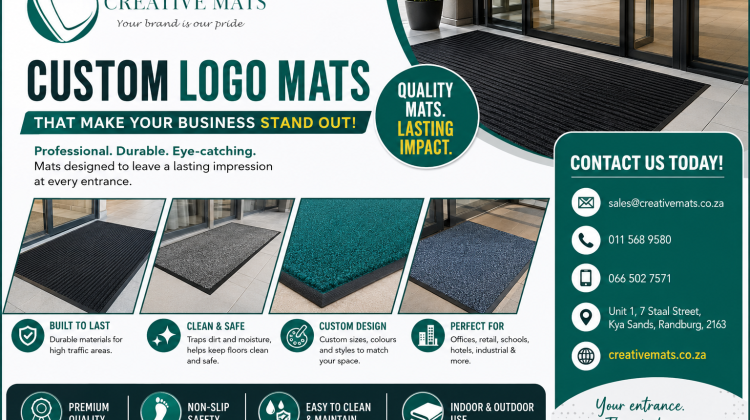
Indoor mats — Berber point mats offer a structured, needle-punched finish with strong stain resistance, making them a solid choice for offices and reception areas. Nylon pile options give a sleeker, low-profile look suited to retail and hospitality spaces where appearance is the priority.
Outdoor mats — Rubber and PVC coil (“spaghetti”) mats are built to handle rain, mud, and UV exposure without breaking down. If your entrance faces the weather directly, this is the category to focus on rather than an indoor-rated mat that looks similar but won’t hold up.
High-traffic mats — Heavy-duty tufted or reinforced-edge mats are designed specifically to withstand constant foot traffic without losing shape, colour, or grip — worth the investment for entrances that see hundreds of people a day.
Get the Size and Shape Right
An undersized mat won’t catch dirt before it reaches your floors, which defeats half the purpose of having one. Measure your actual entrance space, not just the doorway — a mat that extends a few steps past the door catches more dirt and moisture than one that stops right at the threshold. Custom sizing is worth asking about if your entrance is an unusual shape, has a revolving door, or needs to fit into a recessed mat well.
Don’t Skip Safety Features
Anti-slip backing isn’t optional in a commercial setting — it’s one of the simplest ways to reduce slip-and-fall risk, particularly in wet weather or spaces with polished, tiled, or hard flooring. If your entrance is prone to moisture (rainy season entrances, spaces near kitchens or bathrooms), prioritise mats with strong grip and water-drainage properties over ones chosen purely on looks.
Think About Maintenance Before You Buy
A mat that looks great on day one but is a pain to clean will end up neglected — and a dirty, faded mat undermines the exact impression you were trying to create. Ask how easy a mat is to vacuum, spot-clean, or hose down (for outdoor options) before committing, especially if it’s going somewhere with heavy daily use.
Make the Branding Count
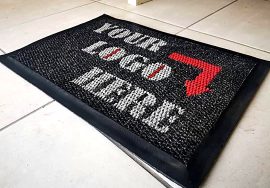
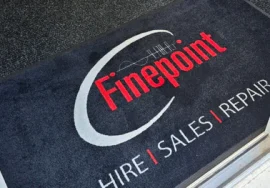
Once function is sorted, branding is where a mat becomes a genuine marketing asset rather than just a floor covering. Vibrant, fade-resistant printing matters here — a logo that looks sharp for the first month but fades within a year isn’t doing your brand any favours. Ask to see a design proof before production, so you know exactly how your logo and colours will look on the finished mat.
The Bottom Line
The right logo mat comes down to matching function, material, and size to your specific entrance — not picking the most attractive option in a catalogue. Get the practical details right (traffic level, weather exposure, safety, size) and the branding value takes care of itself, since a mat that performs well is one people actually notice.
If you’re not sure which combination is right for your space, a quick conversation with a mat supplier who can ask about your entrance, foot traffic, and weather exposure will save you from over- or under-buying — and get you a mat that holds up as well as it looks.